Archive for News

New York Muck Onion Growers explore “Goût de Terroir”

With support from NERCRD, an intrepid group of onion growers in New York state have launched a strategic business planning project to explore collaborative promotion and marketing.

New study examines importance and unique characteristics of U.S. female farmers

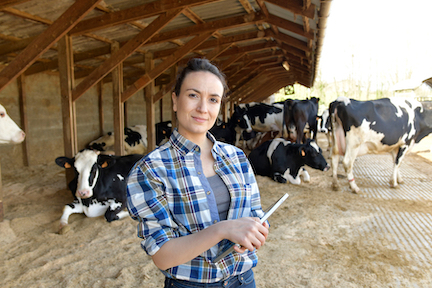
While women can be drawn into farming for many reasons, NERCRD researchers have found that female-owned farms in the U.S. are more common in areas that are closer to urban markets, that engage in agritourism activity, and that offer greater access to childcare.

NERCRD researchers develop new tool for visualizing vulnerabilities in supply chains

The COVID-19 pandemic dramatically exposed the economic vulnerability of U.S. businesses, primarily because they are so interconnected: when one region experiences a labor shortage or supply interruption, adverse effects reverberate throughout the global economy. Researchers at NERCRD and the Korea Rural Economic Institute have developed a model to help visualize the interconnectedness of businesses and industries over geographic space, which potentially can show supply-chain vulnerabilities to future shocks, such as pandemics or climate-change impacts.

New project to explore models for connecting healthcare organizations with local agricultural producers

NERCRD is participating in a one-year project aimed at identifying a sustainable model for connecting regional healthcare organizations with local communities and agricultural producers. The project is funded jointly by the Penn State’s College of Agricultural Sciences and College of Medicine.

Return on investment, public value estimates, and using the “but for” attribution principle

An article recently published in Journal of Extension demonstrates how a team from University of Minnesota Extension quantified the economic benefits of one of their leadership programs using the “but for” attribution principle. This principle is described in detail in “The Impact Indicators Tip Booklet: Practical and Credible Methods for Using the ‘But For’ Rule to Document Extension Community Development Impacts,” published by NERCRD and available online. Hat tip to George Morse for bringing this article to our attention.

Researchers to create a roadmap for fostering successful agritourism enterprises

A team of researchers led by a Penn State agricultural economist will receive $500,000 over three years to study agritourism in the United States and to develop research-based information and guidance for farmers looking to diversify their incomes through agritourism activities.

For small and minority farmers, networks influence the bottom line

In a study looking at the social networks of small-scale and minority specialty-crop farmers in Tennessee, Maryland, and Delaware, farmers who played a more prominent role in their network reported greater sales. The findings can help farming groups and agricultural support organizations leverage networks to enhance the farmers’ success.

Amplifying the Rural Voice: Choices Magazine looks at 2020 Census challenges and opportunities

A collection of articles recently published in Choices Magazine explores the theme of “Amplifying the Rural Voice: 2020 Census Challenges and Opportunities.” Dr. Steve Turner, Director of the Southern Rural Development Center, served as the collection’s guest editor. The articles (including one co-authored by NERCRD and UNH faculty) explore factors associated with lower Census counts; anticipated participation across the rural–urban continuum; strategies for improving participation; and, the importance of the Census to Cooperative Extension programs and services across the U.S. Choices is an outreach publication of the Agricultural and Applied Economics Association, and is freely available online.

Community factors influence how long you’ll live, study shows

While lifestyle choices and genetics go a long way toward predicting longevity, a new study shows that certain community characteristics also play important roles. American communities with more fast food restaurants, a larger share of extraction industry-based jobs, or higher population density have shorter life expectancies, according to researchers from Penn State, West Virginia, and Michigan State Universities. Their findings can help communities identify and implement changes that may promote longer lifespans among their residents.

Innovation is widespread in rural areas, not just cities

Conventional measures of innovation suggest that only big cities foster new ideas, but a more comprehensive measure developed at the Northeast Regional Center for Rural Development shows that innovation is widespread even in rural places not typically thought of as innovative. This “hidden” innovation brings economic benefits to businesses and communities, according to researchers, whose findings will help decision makers think in new ways about innovation and how they can support it.