
NERCRD 2025 Annual Report
February 24, 2026
We invite you to explore our recent work via the NERCRD 2025 Annual Report, available below and as a printer-friendly PDF. If you’d like a printed copy mailed to you, please send a request to nercrd@psu.edu.
Table of Contents
- Letter from the Director
- About the NERCRD
- Economic Development, Innovation, and Resilience
- Food Systems, Nutrition Security, and Agriculture
- Tourism, Agritourism, and Outdoor Recreation
- Capacity Building
- Administrative Updates
- Funding Snapshot
- Presentations and Publications
- See in you in 2026!
- About the RRDCs
- NERCRD Leadership Directory
- Funding Acknowledgement
Letter from the Director
Dear Colleagues,

We are very pleased to share the NERCRD 2025 Annual Report with you, which highlights another year of collaborative work to strengthen rural communities across the Northeast and beyond. This report reflects the breadth of the NERCRD’s mission – advancing research, developing practical tools, and supporting Extension and outreach efforts that help communities navigate change.
The NERCRD’s portfolio has continued to grow and includes an Extension webinar series and related outreach projects. New, NSF-funded research on rural innovation seeks to generate fine-grained insights into how place-based innovation can be measured and fostered in smaller and often overlooked communities. Related research on small business finance, entrepreneurship, and the geography of rural lending is informing rural economic development policies.
The Tourism, Resiliency, and Indicators for Post-Pandemic Planning (TRIP) project showcases how the NERCRD connects universities, state and federal agencies, and local partners. Working with collaborators in PA, VT, NH, and WV, the TRIP team has implemented visitor and resident surveys and produced regional data reports that are helping gateway communities better understand tourism’s role in local resilience and quality of life. This work builds on NERCRD’s longstanding commitment to combining rigorous data analysis with practical decision-support tools.
The joint RRDC multi-region Baseline Survey 2024 has created an open-access dataset on household, business, and community well-being to inform research and policy for years to come. Research on caregiving in the Northeast shows how family responsibilities intersect with labor markets, community supports, and rural development, generating timely evidence for state and local decision makers. These projects further exemplify the NERCRD’s integrative approach.
None of this would be possible without the support and engagement of our many stakeholders and partners. I am thankful to the Technical Advisory Committee and Board of Directors for their guidance, to our RRDC colleagues for their collaboration, and to our federal funders and partners at USDA, NSF, and other agencies for their confidence in the Center’s work, and to the NERCRD staff. We are equally grateful to our university collaborators across the region, to extension professionals who help translate research into practice, and to local leaders, practitioners, and residents who share their time, expertise, and lived experience, ensuring that our work is relevant and impactful.
Thank you for your continued partnership. We look forward to building on these accomplishments together in 2026.
Stephan J. Goetz, Ph.D.
Director and Professor
February 2026
About the NERCRD
The Northeast Regional Center for Rural Development (NERCRD) is one of the nation’s four Regional Rural Development Centers (RRDCs) established by the Rural Development Act of 1972. The RRDCs work in partnership with the land-grant university (LGU) system to address the critical needs of the nation’s rural communities. The NERCRD is hosted at Penn State and serves the 12-state region from Maine to West Virginia and the District of Columbia.
NERCRD accomplishes its goals by:
Facilitating high-impact collaborations across the land-grant system
NERCRD serves as a regional hub for its LGU partners, linking research and Extension faculty across state lines. By facilitating collaborative networks and partnerships, NERCRD enhances the capacity of the LGU system, so that it can work more effectively to foster regional prosperity and rural development.
Leading impactful research
Through a robust research portfolio, NERCRD researchers contribute to the science base so that other researchers and practitioners can better understand and address rural America’s economic development problems. Recent NERCRD research has been used at the highest levels of the federal government, has been cited in groundbreaking studies on the economic mobility of Americans, and has appeared in highly ranked general science, disciplinary, and interdisciplinary journals. A recent paper by NERCRD scientists is ranked in the top 5% of more than 29.4 million research outputs scored by Altmetric, which measures the attention the paper has received and demonstrates its broader impact. NERCRD Director Stephan J. Goetz is ranked among the top 0.5% of agricultural economists in terms of research productivity, impact, and quality according to https://scholargps.com.
Leveraging strong connections to federal resources
The RRDCs have strong connections to federal resources, which facilitate networking with other federal and private funding agencies and stakeholder organizations, and connecting them with the land-grant system. In 2025, the NERCRD leveraged $1.59 in additional extramural funding for each dollar of core funds received from USDA National Institute of Food and Agriculture (NIFA).
How NERCRD is governed:
The NERCRD is administered by a joint agreement between USDA and Penn State (the host institution). Major core funding comes from the USDA NIFA via the U.S. Congress annual appropriations process, and from the region’s land-grant institutions. NERCRD’s Board of Directors is composed of administrators from the regional land-grant institutions and representatives of USDA NIFA and USDA Economic Research Service. With input from NERCRD’s Technical Advisory Committee, the Board establishes policies and programming emphases. In 2025, NERCRD’s emphasis areas were:
- Economic Development, Innovation, and Resilience
- Food Systems, Nutrition Security, and Agriculture
- Tourism and Outdoor Recreation
- Capacity Building and Facilitation
Visit “About NERCRD” to learn more.
Economic Development, Innovation, and Resilience
NERCRD conducts research on the causes and consequences of economic resilience and innovation, and supports outreach that empowers communities to create vibrant local economies.
Rural innovation research
Building on the success and momentum of an earlier USDA NIFA-funded project focused on rural innovation, the NERCRD has several projects underway exploring various aspects of this topic. In collaboration with Timothy Wojan, an Oak Ridge Institute for Science and Education Established Scientist Fellow at the National Center for Science and Engineering Statistics within the U.S. National Science Foundation, this research resulted in the following outputs in 2025:
- Rural Innovative Firms and Credit: Findings from the Annual Business Survey, published in Finance Research Open.
- Explaining the Urban-Rural Export Gap: Evidence from U.S. Firms, published in the Journal of the Agricultural and Applied Economics Association.
- Design: A Critical Input to Rural Innovative Entrepreneurship, published in the Journal of Innovation and Entrepreneurship.
NERCRD’s work in this area was highlighted in opinion pieces by other researchers, underscoring the relevance and importance of this research to rural development efforts:
- If you really want to close the US trade deficit, try boosting innovation in rural manufacturing, by Amitrajeet A. Batabyal, Rochester Institute of Technology, published in The Conversation.
- How innovation is quietly taking root in New Hampshire’s small towns, by Charlie French, University of New Hampshire Extension, published in the New Hampshire Business Review.
NSF EAGER project exploring innovation at smaller scales
With a two-year, $300,000 grant from the U.S. National Science Foundation (NSF), NERCRD researchers Zheng Tian and Stephan J. Goetz and their collaborator Timothy Wojan are developing a new method for measuring innovation in small geographic regions. The project will illuminate the factors that promote or hinder innovation among firms in different U.S. locations, as well as facilitate more targeted and effective local interventions to foster economic growth and social well-being.
Using the Annual Business Survey (ABS), which directly captures diverse forms of innovation but is too sparse for small-area estimates, the research will apply small-area estimation techniques to predict firm-level innovation behavior within the much larger Economic Census (EC). By leveraging statistical modeling, incorporating spatial dependence, and addressing challenges such as complex sampling and multi-unit firm reporting, the project aims to generate Small Area Innovation Rate Estimates (SAIRE). These methods will yield more accurate, fine-grained measures of local innovation, enabling better targeting and evaluation of place-based innovation policies, and advancing research on how innovation shapes rural and urban regional development.
To date, the team has demonstrated the feasibility of using federal business datasets for SAIRE, and estimated a prototype area-level model with promising results, and presented early findings at the 2026 Allied Social Science Associations annual meeting. They also obtained approval for a new Federal Statistical Research Data Center project that has launched, titled, “Leveraging Federal Data Collections for Analysis of the Causes and Consequences of Place-Based Innovation with Small Area Innovation Rate Estimation.” Learn more about the SAIRE project here.
US energy independence: Firm-level insights from the 2023 Annual Business Survey and implications for rural communities
This project is motivated by the massive federal investment in energy transition and the lack of evidence on how firms adapt. The research team applies advanced econometric models using multiple datasets to analyze drivers and barriers to green energy adoption at the establishment level. A central focus is understanding the unique role of rural communities, where open space provides opportunities for energy deployment but local resistance and land-use conflicts — such as those involving agrivoltaics — pose challenges. The researchers expect to gain a better understanding of how firms and communities navigate the costs and trade-offs of recarbonization versus recarbonization, with direct policy relevance for supporting rural businesses, guiding infrastructure siting, and informing the broader transition to a low-carbon economy. Research team members include: Stephan Goetz, Zheng Tian, and Luyi Han (NERCRD/Penn State); and Timothy Wojan (National Center for Science and Engineering Statistics, U.S. National Science Foundation). They presented the preliminary results from this project on three occasions in 2025, including the Penn State Climate Solutions Symposium, the Industry Studies Association Annual Conference, and the North American Regional Science Council conference.
Factors affecting the success of rural entrepreneurs and rural economic vitality
NERCRD has continued work on two distinct projects focusing on different aspects of
this topic:
Small business growth and entrepreneurship development

(WVU AFRI subcontract focused on rural entrepreneurs)
Prior research suggests that expanding entrepreneurship or self-employment is a key strategy for promoting economic growth in rural, distressed regions. This project, led by Heather M. Stephens (West Virginia University), seeks to understand the factors that support or deter entrepreneurship and to translate these findings to help key stakeholders develop policies and programs to support entrepreneurs. Team members presented a workshop drawing on their preliminary findings at the National Association of Community Development Extension Professionals 2025 conference:
- Entsminger, J., Eades, D., Li, X., & Han, L. (2025, June 10). Fostering Inclusive Support Ecosystems: A Community of Practice Conversation on Rural Entrepreneurship and Extension Programming. National Association of Community Development Extension Professionals, Charleston, WV.
Role of access to credit
(Community Reinvestment Act; ERS cooperative agreement)
In collaboration with James Davis and Anil Rupasingha of USDA ERS, NERCRD researchers examined the impact of loans to small business owners from the Rural Business-Cooperative Service (RBCS) program of the USDA. The RBCS program aims to support rural entrepreneurs with funding, training, and expertise to launch and expand ventures, as well as access to employment opportunities in agriculture. The team published a working paper this year describing how the number of financial loans and loan amounts per capita vary across different U.S. county types over the period 2000-2022, using Community Reinvestment Act small business loan data:
- Pan, Y., Goetz, Stephan J., & Zhuang, Y. (2025). Small Business Loans in Different U.S. County Types. NERCRD Rural Development Working Paper #59. https://bit.ly/3ZlQPxO
Groundbreaking survey conducted across all four US regions examines household and community well-being

A new data initiative by the RRDCs has resulted in an open-access dataset available to all researchers nationally. Collected in the groundbreaking, multi-region Baseline Survey 2024, the household-level dataset establishes a baseline to inform policy decisions, community development strategies, and targeted interventions related to regional challenges and opportunities.
The Baseline Survey 2024, conducted in the North Central, Northeast, Southern, and Western regions, was developed by faculty from the North Central and Southern Rural Development Centers and Auburn University. The survey covers topics related to household, business, and community well-being and the conditions, issues, and challenges faced by rural and urban communities and their residents in each region.
One innovative use of the data thus far is the development of an Outdoor Recreation Data Dashboard by researchers at the University of Minnesota Tourism Center. The interactive dashboard summarizes and compares data from the outdoor recreation questions in the survey, providing an opportunity to compare regional and state-level data.
Exploring the caregiving experiences of households in the Northeast US
In 2023, NERCRD partnered with the North Central Regional Center for Rural Development (NCRCRD) and the Penn State Department of Agricultural Engineering to deploy a survey in the Northeast region focused on the caregiving experiences of households in the Northeast U.S. The survey received 4,480 responses from all 13 states in the region, and sheds light on how caregiving intersects with community and economic development in the Northeast region. The team has added a new title to the series of research briefs resulting from this effort, which is available on the NERCRD website. Titles include:
- Rural-suburban-urban differences in caregiving in the Northeast region (New in 2025)
- The economic and social well-being of caregivers in the Northeast region
- What supports do caregivers in the Northeast use and what support do they still need?
- The complex picture of caregivers’ health and well-being in the Northeast region
Center staff also collaborated with the other RRDCs to host a national webinar to share findings from a related project, which looked at the financial and mental health supports available to farmers in the Midwest. More than 120 people registered for the webinar to gain insights from the first two years of a five-year project aimed at understanding what the landscape of support in the Midwest looks like and how farmers engage with it. Programmatic and policy implications of these findings, along with the project’s next steps, also were shared.
Tourism, Agritourism, and Outdoor Recreation
Tourism, hospitality, and outdoor recreation make up a rapidly growing segment of the economy and offer an important economic growth strategy to rural and urban communities of all sizes. NERCRD conducts research on the role of tourism and agritourism on economic resilience, and also provides critical support to networks of Extension and research faculty working in these areas.
Fostering sustainable growth in Pennsylvania’s Allegheny National Forest (ANF)
Tourism, Resiliency, and Indicators for Post-Pandemic Planning (TRIP) Project results in new partnerships and opportunities in northern PA.

This project is an excellent example of how the NERCRD is able to network universities and bring capacity across state lines to where it is needed. The NERCRD is working with local stakeholders in the ANF’s gateway communities — including collaborators at the Pennsylvania Wilds, the PA Department of Natural Resources, and the PA Department of Community and Economic Development, and Penn State Extension — to implement the TRIP Project. Led by Doug Arbogast, West Virginia University Extension, this USDA AFRI-funded project seeks to enhance the sustainability and resiliency of rural destinations by providing research-based information and a destination management framework for rural gateway destinations.
In 2024, the project team — which includes collaborators from the National Extension Tourism Design Team, Penn State, University of Vermont, University of New Hampshire, and the NERCRD — conducted visitor and resident surveys in northwestern Pennsylvania, the Upper Valley (UV) region on the Vermont/New Hampshire border, and the Monongahela National Forest (MNF) region of West Virginia. The team also produced Economic and Quality of Life data reports for each of the regions using a variety of secondary data sources, and conducted Tourism First Impressions (TFI) assessments in the UV and MNF regions, with plans for the ANF assessment to take place in April 2026. The TFI program creates an exchange between people from two or more destination regions, where the visitor group provides feedback to representatives from the host region regarding their perceptions of tourism strengths and opportunities. These materials are available via the project webpage.
NERCRD has been collaborating with a local program team from Penn State Extension to implement the next phase of the grant, working with local community leaders and organizations on how to use the survey data to inform decision making around outdoor recreation, economic development, conservation, and tourism in the ANF region. The team from Penn State Extension includes educators Chi Catalone, Harry Crissy, Travis Wingard and Client Relations Manager Robert Dickinson.
The Rural Tourism Institute: Leveraging land-grant universities to support sustainable rural tourism development in Appalachia
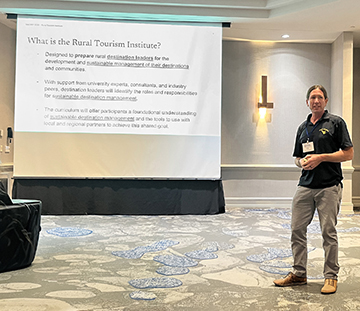
This project is led by Doug Arbogast, Rural Tourism Development Extension Specialist at West Virginia University. The project team includes collaborators from North Carolina State Extension Tourism, the Community and Economic Development Initiative of Kentucky, the Northeast and Southern Regional Rural Development Centers, prominent tourism industry consultants, and community partners across three Appalachian states. The project has three components:
- the Rural Tourism Academy, which will develop the industry’s first Rural Tourism Executive Certification program;
- the Rural Tourism Peer Network, which will provide facilitated networking and information sharing among practitioners; and,
- the Rural Tourism Lab, which will leverage academic faculty and students to fill critical data and intelligence gaps and provide planning and research support.
It was funded as a planning grant from the Appalachian Regional Commission to develop the curriculum and beta test the research methods. The team is in the process of developing an implementation grant proposal that, if funded, could allow for implementation of the Academy and Lab in select Appalachian counties in 2027.
NERCRD team members have engaged most directly with the Rural Tourism Lab, by serving in an advisory capacity and by participating in the development of research methods and prototypes. These research products include resident sentiment and visitor preferences surveys, GIS asset inventory and analysis, economic impact analysis, mobile phone data analysis, credit card spending analysis, and quality of life and tourism data dashboards. Visit the Rural Tourism Institute website.
Creating an agritourism support system
Drawing on extensive stakeholder input, guidance, and collaboration, the goal of this four-year project led by Claudia Schmidt, an associate professor of marketing and local/regional food systems at Penn State, is to develop and disseminate practical information that will allow small and medium-sized farmers and rural communities to benefit from the growing consumer interest in agritourism activities. NERCRD supported the development of three project outputs this year:
- Schmidt, C., Entsminger, J. S., Cornelisse, S., & Schweichler, J. (2025). Insights on Agritourism Among US Producers: Evidence from the 2024 National Agritourism Producer Survey. (NERCRD Data Brief No. 2025–1).
- Entsminger, J. S., Schmidt, C., Cornelisse, S., & Schweichler, J. (2025). Insights on Agritourism Among Maine Producers: Evidence from the 2024 National Agritourism Producer Survey. NERCRD Data Brief No. 2025-02.
- Entsminger, J. S., Schmidt, C., Cornelisse, S., & Schweichler, J. (2025). Insights on Agritourism Among Producers in Western U.S. States: Evidence from the 2024 National Agritourism Producer Survey (NERCRD Data Brief No. 2025–3).
Other tourism, agritourism, and outdoor recreation activities
- NERCRD’s Stephan Goetz continued to contribute to a complementary and separately funded Hatch project led by Doug Arbogast (West Virginia University) examining sustainable tourism development indicators. The project (number NE2251) is titled “Tourism Resilience and Community Sustainability: Adaptation and Recovery of Rural Businesses and Destinations.”
- NERCRD continued to support the National Extension Tourism Network and the National Outdoor Recreation Working Group. See page 13 for details.
Food Systems, Nutrition Security, and Agriculture
In addition to its agritourism programming, NERCRD also conducts research focused on agricultural profitability, market opportunities, and the role of rural communities in supporting a vibrant agricultural sector.
Survey to provide insights on farm loss, transition, and succession

NERCRD collaborated with Penn State Extension, the PA Department of Agriculture, and PA Farm Link on the development and distribution of a survey about farm transition, succession planning, and generational change in the Northeast. NERCRD widely promoted this survey, which was open to any farmer in the region, and is currently assisting with the regional analysis. The research team will release results in 2026, which will shed light on the impact of farm transitions on rural communities and economies and on the region’s ongoing ability to contribute to the nation’s food supply.
NERCRD research recognized for high impact
A paper by Claudia Schmidt, Steven Deller (University of Wisconsin-Madison), and Stephan J. Goetz was selected as the 2025 High Impact Research Publication in the category of Human and Community Dynamics by Penn State’s College of Agricultural Sciences. The researchers found that having more women in agriculture is associated with greater community well-being. Their work is the first to quantitatively assess this link, and their findings suggest that women farmers approach their operations in ways that positively impact their communities:
- Claudia Schmidt, Steven C. Deller, and Stephan J. Goetz. “Women farmers and community well-being under modeling uncertainty.” Applied Economic Perspectives and Policy 46, no. 1 (2024).
- Read a Penn State News article about this research.
Capacity Building and Facilitation
NERCRD serves as a regional hub for its Land-Grant University (LGU) partners, linking research and Extension faculty across state lines. By facilitating collaborative networks and partnerships, we enhance the capacity of the LGU system to work more effectively to foster regional prosperity and rural development.
Supporting the Northeast’s community and economic development Extension leadership
The Northeast Regional Leaders in Community and Economic Development, a 15-member cohort of Extension program leaders and others who play a leadership role in their state, have been meeting monthly since 2023 under the support and leadership of Ali Dunnigan (Northeast Extension Directors) and Hannah Carter (University of Maine). Beginning in September 2025, Ali and Hannah transitioned their leadership of this group to new co-chairs Jason Entsminger, University of Maine, and NERCRD’s Stephen Alessi, who will partner to provide this leadership and support going forward. We are thankful to Ali and Hannah for convening and facilitating this group during the last two years, providing the opportunity to collaborate on program priorities that are important to the Northeast region, which in turn helps build capacity in this program area.
NERCRD webinar series: Engaging new audiences and partners
The NERCRD webinar series, spearheaded in 2024 by Associate Director Stephen Alessi, continued this year with two webinars held in the spring and two in the fall. The webinar series has proven to be NERCRD’s best avenue for reaching new audiences, with more than 100 people signing on to the newsletter mailing list via webinar registrations in 2025. Webinar presenters included research and Extension professionals from University of Maryland, University of Rhode Island, Penn State, West Virginia State University, and West Virginia University, and resulted in new collaborations to expand programming in other states.
Land-use planning webinar series with Penn State Extension
In a new collaboration led by Stephen Alessi, NERCRD has partnered with Penn State Extension (John Turack) and the Pennsylvania Chapter of the American Planning Association on co-organizing a webinar series focused on land-use issues. The Land-Use Planning Webinar Series provides monthly in-depth presentations on land-use topics for landowners/managers, farmers, elected and appointed officials, developers, and community members who are involved in decision-making processes regarding using or preserving natural resources and the Commonwealth’s land base. While the topics have focused on issues pertinent to Pennsylvania, many of these issues are relevant to communities throughout the Northeast. Topics covered in 2025 include:
- The Economic Impact of Small Farms: What it Means for Community Plans and Planners (Presented by Timothy W. Kelsey and Ted Ritsick)
- Local Ordinances and Green Infrastructure in Pennsylvania (Presented by Christine Kirchhoff and Bhavik Gupta)
- Current Pennsylvania Solar Development Trends: Update for Municipal Leaders (Presented by Matt Svetz and Rob Davidson)
- Stormwater Management Planning and Community Trees: Green Infrastructure for the Future (Presented by Vincent Cotrone)
- Practical AI for Community Development and Planning: Tools, Tips, and Useful Everyday Applications (Presented by Jim Ladlee and John Turack)
- Motivating and Engaging Volunteers in Local Governance and Community Planning (Presented by Neal Fogle, Suzanna Windon, and Molly Kathleen Sarver)
- Addressing the Housing Crisis: Collaborative Approaches to Developing Local Solutions with Insights from the New Hampshire Housing Academy and the InvestNH Program (Presented by Stephen Alessi, Scott Slattery, Sarah Wrightsman, Sue Cagle, and George Reagan)
- Data-Driven Decision-Making: Understanding How Data Informs Community Planning and Policy Development (Presented by Kara Salazar and Jeff Raykes)
- Changes in Pennsylvania Demographics: Trends and Shifts Impacting Communities and Panning Efforts (Presented by Kyle Kopko)
- The Impact of Tourism and Outdoor Recreation: Exploring Economic Effects at Local and State Levels (Presented by Doug Arbogast, Katie Wickert, and Nathan Reigner)
The series will continue in 2026, and will feature presentations on planning for intergenerational communities, community food access, rural housing affordability and livability, and more. More information is available at the webinar series home page.
National Extension Outdoor Recreation Working Group
NERCRD has facilitated monthly meetings of the National Extension Outdoor Recreation Working Group (NEORWG) Steering Committee since Summer 2023 in collaboration with its founding co-chairs, Doug Arbogast (West Virginia University) and Jake Powell (Utah State University). Their goal is to support the sustainable development of the recreation economy nationwide through partnership-focused approaches that expand Cooperative Extension’s capacity to develop and deliver research-based resources. The primary impact resulting from NERCRD’s support is the emergence of new collaborations and regional knowledge-sharing networks. For example:
- Working Group (WG) members from Penn State, University of Vermont, and University of New Hampshire have formed collaborative partnerships leading to multi-state grant proposals.
- WG members from The Ohio State University and the University of Minnesota partnered on an NCRCRD grant to develop an Outdoor Recreation sector curriculum, which led to multiple national presentations, and provided a tool for implementing Outdoor Recreation aspects of a county-based Economic Development Strategic Plan in Ohio.
- Through the regional relationships established in this WG, members in the West collaborated on a successful research proposal funded by the Western Rural Development Center ($31K) to compile state-level outdoor recreation metrics and to explore Extension’s role in the outdoor recreation economy.
- WG members worked with their respective RRDCs to hold listening sessions in the North Central, Southern, and Western regions to explore how Extension can support collaboration and grow partnerships around outdoor tourism in these regions.
- WG members from the University of Wyoming and Colorado State University collaborated to launch a knowledge-exchange webinar series featuring industry experts, government representatives, and resource agencies who share insights, best practices, and strategies to help enhance outdoor recreation in the West. Launched in 2024, this initiative grew in 2025 to include WY, CO, MT, UT, and CA.
- WG members lent their expertise to the development of the outdoor economy section of the NCR-Stat: Baseline Survey 2024, which resulted in outdoor recreation data available to all researchers nationally.
- Using these data, University of Minnesota’s Tourism Center created a publicly accessible outdoor recreation dashboard.
- WG members from California leveraged knowledge and resources shared in the monthly meetings to inform the development of CA’s outdoor recreation programming and of position descriptions for a statewide specialist and a regional advisor in Community and Economic Development and Outdoor Recreation. These new positions will be filled in 2026.
Measuring the Northeast’s community development capacity
NERCRD Associate Director Stephen Alessi conducted an inventory of the research and Extension programming taking place across the Northeast land-grant system that corresponds with the NERCRD priority areas of: Economic Development, Resilience, and Innovation; Tourism and Outdoor Recreation; and Food Systems, Nutrition Security, and Agriculture. In addition to providing insights into the region’s strengths and opportunities in this area, the study also serves to identify potential partners for collaborative work within the Northeast. Key takeaways include:
- A total of 386 people were identified as faculty, specialists or educators working in program areas that align with NERCRD’s current priorities. (See graph below.)
- Tourism and Agritourism currently have the smallest capacity in the region, relative to other priority areas.
- The Northeast is working on many different program areas that have potential cross-cutting impacts on rural development including housing and community planning, broadband access, digital skills, and food system resilience.

These findings suggest that, given the wide-ranging programming areas present in the region, there is an opportunity to collaborate on cross-cutting issues that impact rural communities. These include housing and community planning, broadband access, digital skills (workforce and personal development), and food system resilience. The formation of regional program teams to work on these complex issues can help bring diverse ideas to achieve comprehensive solutions. Using the widespread housing shortage as an example, members from the program areas of Community Development; Food, Families and Health; and Community Planning, could all contribute meaningfully to informing a regional Extension response to the current housing situation. While some ground-truthing is still underway, Alessi presented the preliminary results at NACDEP via a poster.
NERCRD outreach: Meeting stakeholders where they are
NERCRD staff attended numerous national events for in-person networking and engagement and to share the work of the RRDCs.
National Association of Community Development Extension Professionals

NERCRD was proud to sponsor this year’s conference of the National Association for Community Development Extension Professionals (NACDEP), hosted in June by West Virginia State University in Charleston, WV. The conference sold out well ahead of its registration deadline, and 266 people attended. In addition to making a poster presentation (see preceding item), Stephen Alessi represented the NERCRD at its sponsorship table and also participated in the Rural Entrepreneurship Workshop led by Heather Stephens (WVU), Jason Entsminger (UMaine) and Luyi Han (NERCRD/PSU).
Alessi also played a critical role in convening this year’s planning committee for the annual meeting of state Community and Economic Development (CED) program leaders, which is held annually in conjunction with NACDEP. The meeting was led by Alessi and a planning committee composed of community and economic development program leaders from each region. The focus of the meeting was to connect, share solutions, and build forward momentum in CED work, and it provided the opportunity for attendees to explore the various aspects of CED programming in Extension, including future directions, how these programs are structured across various institutions and avenues for building bridges across other Extension program areas. It included a presentation from Dr. James Barnes (Mississippi State University) titled “Marketing for Community Development Programs.”
NETtra (NET X NETTRA) 2025 Tourism Conference
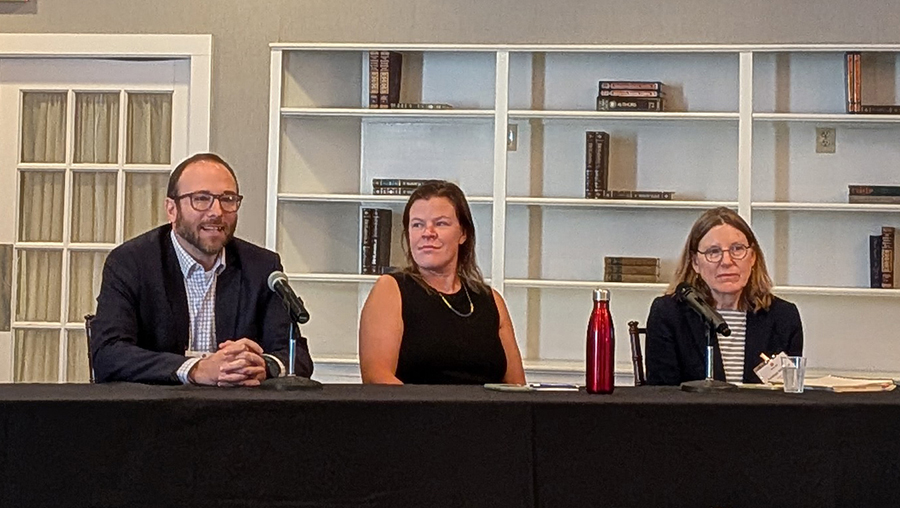
In October, Stephen Alessi and Kristen Devlin attended the joint conference of the National Extension Tourism Network (NET) and the Northeast Chapter of the Travel and Tourism Research Association (NETTRA), which NERCRD also sponsored this year. They participated in the NET Design Team strategic planning session and the National Extension Outdoor Recreation Working Group workshop, and staffed the NERCRD sponsorship table aimed at raising the RRDCs’ visibility among conference participants. Alessi also served on a panel discussion, “Effective Collaborations for Stronger Destinations,” along with Whitney Knollenberg (North Carolina State University) and Penelope Whitman (Discover Sugar River Region), pictured at left.
National Digital Extension Education Team (NDEET)
In late July, 27 members of the National Digital Extension Education Team (NDEET) gathered in Denver, CO, for an energizing and forward-focused meeting to identify the emerging digital and broadband needs shaping the future of Cooperative Extension. Hosted by the Extension Foundation, the event served as a catalyst for strategic planning and collaboration across key issue areas. Stephen Alessi attended the event and is excited about the opportunities to collaborate on the program priority areas that emerged from the meeting. The NDEET Strategic Planning Team identified three priority areas for research and content development: Economic Development; Artificial Intelligence and Emerging Technology; and Cybersecurity. Each focus area has defined a clear set of goals and action steps to support Cooperative Extension’s evolving role in digital opportunity and innovation, and subgroups have already begun meeting to develop their plans of work going forward.
Pennsylvania Ag Summit and Ag Progress Days

NERCRD staff participated in two events in Pennsylvania to learn about the challenges and opportunities in the agricultural sector and to share how the Regional Rural Development Centers’ work intersects. The first was the 7th annual Pennsylvania Ag Summit hosted by the Chair of the U.S. House Committee on Agriculture, U.S. Representative Glenn “GT” Thompson (PA-15), which focuses on showcasing Pennsylvania’s agriculture industry. The second was Ag Progress Days, Pennsylvania’s largest outdoor agricultural exposition, hosted by Penn State’s College of Agricultural Sciences.
“Cultivating Rural Health” convening at Penn State
Stephen Alessi attended a one-day event focused on the capacity of the Penn State College of Agricultural Sciences to support the health of Pennsylvanians, especially those in rural communities. The organizers sought to gauge interest and capacity among attendees to engage in rural health-related research, education, and outreach; identify and map existing resources; and foster interdisciplinary collaboration through facilitated discussions and strategic planning. Alessi will remain engaged as next steps take shape.
2025 Maryland Digital Opportunity Summit
The MD Digital Opportunity Summit was held in October in Silver Springs, MD, and brought together people from education, government, technology, and community organizations to learn and discuss opportunities to increase broadband access and develop digital skills to increase economic opportunities for residents of Maryland. Stephen Alessi attended and participated in discussions about the potential impacts of emerging technology on rural communities and the importance of broadband access in rural communities. A coalition-building session focused on regional and statewide collaborations to address digital opportunities and strategies going forward. The Summit also featured panel discussions on workforce development, community engagement and policy and advocacy work.
Administrative Updates
A fond farewell to Kim Boonie and a warm welcome to Carol DeArmitt!

The NERCRD team bid a fond farewell to Kim Boonie, who retired from her position as NERCRD Business Manager at the end of August. In her six years in this role, Kim made several improvements to NERCRD operations and helped keep things running smoothly through major transitions, including the adoption of a new University financial system, the shift to remote work and back, staffing changes, changes in rules governing NERCRD grants, new grants, and more. Kim is looking forward to many post-retirement trips with her husband, Randy, and more time to spend with their children and grandchildren. Read more at: https://bit.ly/45iFQc1.

The team was thrilled to welcome new NERCRD Business Manager, Carol DeArmitt, in November. Carol has been employed at Penn State for nine years in various capacities, most recently as an administrative assistant in the Office of the Senior Vice President for Research (OSVPR), where her duties included reviewing and approving financial transactions and expense reports. She also worked closely with OSVPR leadership on projects such as Non-Tenure Line Promotion and Tenure and director searches, and provided general office support. Carol is a graduate of the Penn State ACOR Certification & Education Series (ACES). The ACES program is an education and certification program developed by the Administrative Committee on Research and co-sponsored by the Office for Research Protections. Carol is excited to share and expand her knowledge on this new journey with NERCRD.
Funding Snapshot
In 2025, the NERCRD generated $1.59 in additional grants for every $1.00 in core funding.

Through its core federal investment, the NERCRD is able to build strong collaborative networks in the Northeast and across regions and work across federal, state, and private agencies to secure funding with partners to address the nation’s pressing rural development issues. NERCRD’s 2025 grant portfolio included:
| Core Funding | Sponsor | Start Date | End Date | Amount |
|---|---|---|---|---|
| The Northeast Regional Center for Rural Development – FY2023 | USDA NIFA | 9/1/23 | 8/31/26 | $704,232 |
| The Northeast Regional Center for Rural Development – FY2024 | USDA NIFA | 9/1/24 | 8/31/26 | $617,167 |
| The Northeast Regional Center for Rural Development – FY2025 | USDA NIFA | 9/15/25 | 8/31/26 | $613,979 |
NERCRD-led non-core grants | Sponsor | Start Date | End Date | Amount |
|---|---|---|---|---|
EAGER: PBI:Assessing Societal and Economic Impacts of Place-Based Innovation with Small Area Innovation Rate Estimation | U.S. National Science Foundation | 9/1/24 | 8/31/26 | $299,998 |
| U.S. Energy Independence: Firm-level Insights from the 2023 Annual Business Survey and Implications for Rural Communities | USDA NIFA | 7/1/24 | 6/30/27 | $650,000 |
| Small, Rural Businesses, Food Security, Innovation and Access to Credit in Rural America | USDA NIFA | 9/27/22 | 8/31/26 | $349,986 |
| Additional funds with partners | Sponsor | Start Date | End Date | Amount |
|---|---|---|---|---|
| Creating an Effective Support System for Small and Medium-Sized Farm Operators to Succeed in Agritourism (C. Schmidt, PD) | USDA NIFA via Penn State | 7/1/20 | 6/30/26 | $498,051 (Total amount granted, including NERCRD portion.) |
| Factors Affecting the Success of Rural Entrepreneurs and Rural Economic Vitality (H. Stephens, PD) | USDA NIFA via West Virginia University | 5/15/23 | 5/14/26 | $143,905 (NERCRD portion) |
Rural Community Well-Being: Using Tourism Indicators to Identify, Understand and Address COVID-19 Pandemic Impacts and Strategies for Resiliency (D. Arbogast, PD) | USDA NIFA via West Virginia University | 9/1/22 | 12/31/26 | $200,301** (NERCRD portion) |
Presentations and Publications
- 5 scientific journal articles
- 7 data briefs and working papers
- 14 webinars organized or supported
- 30+ conference presentations
- Top 5% of all research outputs scored by Altmetric ( The NERCRD-led paper, Explaining the Urban-Rural Export Gap: Evidence from U.S. Firms, is ranked in the top 5% of more than 29.4 million research outputs scored by Altmetric.)
- Top 0.5% of agricultural economists (Stephan J. Goetz ranked among the top 0.5% of agricultural economists in terms of research productivity, impact and quality, in 2024 (the most recent year available), according to https://scholargps.com.)
Selected peer-reviewed publications
- Entsminger, J., Green, J.J., Wiatt, R., & Bednarik, Z. (2024). Multi-method research in the digital age: A methodological case study of a broad-scale rapid rural appraisal. Community Development, 1–20. https://doi.org/10.1080/15575330.2024.2438011
- Goetz, Stephan J. (2025). Carbon, Growth and Politics: U.S. States in the Early 21st Century. Review of Regional Studies, 2024(54), 197–214.
- Han, L., Wojan, T. R., Rupasingha, A., & Goetz, S. J. (2025). Rural Innovative Firms and Credit: Findings from the Annual Business Survey. Finance Research Open, 100051. https://doi.org/10.1016/j.finr.2025.100051
- Han, L., Wojan, T. R., Tian, Z., & Goetz, S. J. (2025). Explaining the Urban-Rural Export Gap: Evidence from U.S. Firms. Journal of the Agricultural and Applied Economics Association. https://doi.org/10.1002/jaa2.70009
- Wojan, T. R., Han, L., Tian, Z., & Goetz, S. J. (2025). Design: A critical input to rural innovative entrepreneurship. Journal of Innovation and Entrepreneurship, 14(1), 67. https://doi.org/10.1186/s13731-025-00528-2
Technical Publications
- Entsminger, J. S., Schmidt, C., Cornelisse, S., & Schweichler, J. (2025a). Insights on Agritourism Among Maine Producers: Evidence from the 2024 National Agritourism Producer Survey (NERCRD Data Brief 2025-2).
- Entsminger, J. S., Schmidt, C., Cornelisse, S., & Schweichler, J. (2025b). Insights on Agritourism Among Producers in Western U.S. States: Evidence from the 2024 National Agritourism Producer Survey (NERCRD Data Brief 2025-3).
- Pan, Y., Goetz, Stephan J., & Zhuang, Y. (2025). Small Business Loans in Different U.S. County Types. NERCRD Rural Development Working Paper No. 59.
- Pojman, E., & Becot, F. (2025). Rural-Suburban-Urban Differences in Caregiving in the Northeast U.S. Region. NERCRD Research Brief. https://doi.org/10.22004/AG.ECON.358892
- Schmidt, C., Arbogast, D., Deng, J., & Goetz, S. J. (2025). Fostering Sustainable Growth in Pennsylvania’s Allegheny National Forest (ANF) [Penn State Extension Article].
- Schmidt, C., Entsminger, J. S., Cornelisse, S., & Schweichler, J. (2025). Insights on Agritourism Among US Producers: Evidence from the 2024 National Agritourism Producer Survey (NERCRD Data Brief 2025-1).
Selected presentations
- Alessi, S. (2025, June 9). Program Leaders Meeting at 2025 National Association of Community Development Extension Professionals (NACDEP) Conference, Charleston, WV.
- Alessi, S. (2025, June 11). Community and Economic Development Capacity in the Northeast [Poster]. 2025 NACDEP Conference, Charleston, WV.
- Alessi, S., Knollenberg, W., Whitman, P., & Valdecanas, T. (2025, October 10). Effective Collaborations for Stronger Destinations (Panel Discussion). 2025 Joint Conference of the National Extension Tourism Network and the Northeast Travel and Tourism Research Association (NETtra 2025), Meredith, NH.
- Entsminger, J., Eades, D., Li, X., & Han, L. (2025, June 10). Fostering Inclusive Support Ecosystems: A Community of Practice Conversation on Rural Entrepreneurship and Extension Programming [Workshop]. 2025 NACDEP Conference, Charleston, WV.
- Goetz, S.J.. (2025, June 9). NERCRD Overview. Rural Action Caucus, National Association of Counties, online.
- Goetz, S.J., & Alessi, S. (2025, March 6). NERCRD Overview. Northeast Extension Directors Retreat, online.
- Han, L., Goetz, S.J., Eades, D., & Arbogast, D. (2025a). Economic and Quality of Life Indicators for Allegheny National Forest Counties in Pennsylvania, online presentation to stakeholders.
- Han, L., Goetz, S.J., Eades, D., & Arbogast, D. (2025b). Economic and Quality of Life Indicators for Monongahela National Forest Counties in West Virginia, online presentation to stakeholders.
- Han, L., Goetz, S.J., Eades, D., & Arbogast, D. (2025, April 3). Sustainable Tourism Indicators Using Secondary Data. Southern Regional Science Association, Louisville, KY.
- Han, L., Li, L., Xiaoyin, Tian, Z., Stephens, H.M., & Goetz, S.J. (2025, November 14). Self-Employment Dynamics During Economic Crises: Formation, Survival, and Status Transitions. 2025 North American Regional Science Council (NARSC) Meeting, Denver, CO.
- Han, L., Tian, Z., Goetz, S.J., Li, X., & Stephens, H.M. (2025, April 3). Heterogenous Drivers of Self-Employment and Income: Evidence from Confidential Administrative and Census Data. Southern Regional Science Association, Louisville, KY.
- Kim, M. (2025d, April 5). Peer Effects in Electric Vehicle Adoption. Southern Regional Science Association, Louisville, KY.
- Kim, M., & Goetz, S.J. (2025, November 12-15). The impact of energy price shocks on US local industries. 2025 NARSC Meeting, Denver, CO.
- Kim, M., Tian, Z., Wojan, T., & Goetz, S.J. (2025, November 12-15). Carbon Performance and Location: The Relationship Between Open Space and Industrial Disamenities. 2025 NARSC Meeting, Denver, CO.
- Rupasingha, A., Davis, J., Dinterman, R., Goetz, S.J., & Tian, Z. (2025, September 26). Evaluating the Impact of the USDA Business and Industry Program on Rural Business Growth: Evidence from Matching and Staggered Difference-in-Differences Analysis. 2025 Federal Statistical Research Data Center Conference, Ithaca, NY.
- Schmidt, C., & Entsminger, J.S. (2025, April 23). 2024 National Agritourism Producer Survey. National Extension Tourism webinar, online.
- Tian, Z., & Goetz, S.J. (2025, November 12-15). Divergent Housing Affordability and Livability Trends Across U.S. County Types: The Roles of Mobile Homes and New Construction, 2013–2023. 2025 NARSC Meeting, Denver, CO.
- Tian, Z., Han, L., & Goetz, S.J. (2025, May 19). Decarbonization in Manufacturing: Prevalence, Rationale, and Methods (Poster). Penn State Climate Solutions Symposium, University Park, PA.
- Tian, Z., Kim, M., Kay, D., & Goetz, S.J. (2025a, February 11). Energy Expansion on U.S. Farms: Quantifying the Role of State Renewable Portfolio Standards in Adoption Patterns (2012–2022). BK21 Colloquium at Seoul National University, Seoul, Korea.
- Tian, Z., Kim, M., Kay, D., & Goetz, S.J. (2025b, April 5). Energy Expansion on U.S. Farms: Quantifying the Role of State Renewable Portfolio Standards in Adoption Patterns (2012–2022). Southern Regional Science Association, Louisville, KY.
- Tian, Z., Rupasingha, A., Davis, J., Dinterman, R., & Goetz, S.J. (2025, November 12-15). Evaluating the Impact of the USDA Business and Industry Program on Rural Business Growth: Evidence from Matching and Staggered Difference-in-Differences Analysis. 2025 North American Regional Science Council Conference, Denver, CO.
- Tian, Z., Wojan, T., Li, Y., & Goetz, S.J. (2025, November 12-15). Location Patterns of U.S. Microgrid Deployment Driven by Energy Sources. 2025 North American Regional Science Council Meeting, Denver, CO.
- Wojan, T., Kim, M., Tian, Z., & Goetz, S.J. (2025, November 12-15). Open Space and the Development and Adoption of Onsite Renewable Energy. 2025 North American Regional Science Council Meeting, Denver, CO.
- Wojan, T., Tian, Z., Han, L., & Goetz, S.J. (2025, September 26). Extending Place-Based Innovation Policy to Rural Areas: Using Oaxaca-Blinder Decomposition to Identify Endowment Deficiencies. 2025 Federal Statistical Research Data Center (FSRDC) Conference, Ithaca, NY.
- Zhuang, Y. (2025, June 24). Divergence-in-Convergences: Regional Vulnerability and Resilience to the Green Transition. Western Economic Association International, San Francisco, CA.
- Alessi, S. (2025, October 14). Penn State Community Health Convening. State College, PA.
News releases and newsletters
- Bohn, K. (2025, September 30). Innovative businesses may be less likely to be approved for credit loans. Penn State News.
- NERCRD. (2025c, June 18). Strategic design approach boosts rural innovation, researchers find. Penn State News.
- NERCRD. (2025a, March 11). NERCRD Newsletter, March 2025. https://bit.ly/4rrJVDu
- NERCRD. (2025b, April 30). NERCRD Newsletter, April 2025. https://bit.ly/4bteLXE
- NERCRD. (2025d, July 15). NERCRD Newsletter, July 2025. https://bit.ly/4qOg7AO
- NERCRD. (2025f, August 25). NERCRD Newsletter, August 2025. https://bit.ly/4qkbayY
- NERCRD. (2025g, November 11). NERCRD Newsletter, November 2025. https://bit.ly/4rtmf1z
Selected webinars organized and/or facilitated by NERCRD
- Becot, Florence, Carrie Henning-Smith, Andrea Bjornestad, and Sarah Ruszkowski. 2025. “The Landscape of Mental Health and Financial Support for Midwest Farmers.” RRDC Webinar, September 30. https://youtu.be/PUxoTDZHKK8.
- Catalone, C., Kaplan, M., & Turack, J. (2025, October 29). Intergenerational Living—The Ridgway and Freeport Pilot Projects. NERCRD Webinar Series.
- Missimer, A., & Venturini, V. (2025, April 8). Food Recovery for Rhode Island. NERCRD webinar series.
- Mumm, T., & Slivka, J. (2025, March 20). Marylanders Online: Bridging the Digital Divide in Rural Communities. NERCRD webinar series.
- Thurman, H., Young, A., & Bolin, J. (2025, November 18). Healthy Grandfamilies: Strengthening Families Across Generations. NERCRD webinar series.
- See information on the Penn State Land-Use Planning Webinar Series.
See you in 2026!
Members of the NERCRD team will be at several conferences and meetings in 2026, and look forward to connecting with you!
Southern Regional Science Association
March 19-21 | Louisville, KY
https://www.srsa.org/conference/
National Association of Community Development Extension Professionals June 15-18 | Wichita, KS
https://www.nacdep.net/2026-nacdep-conference
North American Regional Science Council
DATE TBD | Philadelphia, PA
https://www.narsc.org/newsite/conference/
Agricultural and Applied
Economics Association
July 26-28 | Kansas City, MO
https://www.aaea.org/meetings/2026-aaea-annual-meeting
About the Regional Rural Development Centers
The Regional Rural Development Centers (RRDCs) are regionally focused centers hosted by four land-grant universities and funded by the United States Department of Agriculture (USDA) National Institute of Food and Agriculture (NIFA) to work with the nation’s land-grant university system to form innovative research and Extension partnerships in rural development.
Established by the Rural Development Act of 1972, each Center serves a U.S. region and seeks to strengthen the capacity of its region’s land-grant institutions to address a wide range of rural development issues unique to its region.
The Northeast Regional Center for Rural Development Leadership Directory
Board of Directors
Land-Grant University Directors
Richard Rhodes III, Ph.D., Chair
University of Rhode Island
agInnovation Northeast
Moses T. Kairo, Ph.D.
University of Maryland Eastern Shore
Jinhee Kim, Ph.D.
University of Maryland
(effective October 1, 2025)
Troy Ott, Ph.D.
Penn State University
(effective October 1, 2025)
Brian Schilling, Ph.D.
Rutgers, The State University of New Jersey
Blair D. Siegfried, Ph.D.
Penn State University
(until June 30, 2025)
Lisa Townson, Ph.D.
University of Rhode Island
(until October 1, 2025)
Non Land-Grant University Directors (ex-officio)
James Davis, Ph.D.
USDA Economic Research Service
Edwin Lewis, Ph.D.
USDA National Institute of Food and Agriculture
(May – December 2025)
Sarah Rocker, Ph.D.
USDA National Institute of Food and Agriculture
(until May 2025)
Technical Advisory Committee
Heather Stephens, Ph.D., Chair
West Virginia University
David Abler, Ph.D.
Penn State University
Doug Arbogast, Ph.D.
West Virginia University
Adam Hodges
West Virginia State University
David Kay
Cornell University
Shannon Rogers, Ph.D.
University of New Hampshire
Kirstin Yeado
Ascendium Education Group
NERCRD Faculty, Staff, and Students (all at Penn State)
Stephan J. Goetz, Ph.D.
Director and Professor of Agricultural and Regional Economics
Stephen Alessi
Associate Director
Kim Boonie
Business Manager
(until August 31, 2025)
Carol DeArmitt
Business Manager
(effective November 14, 2025)
Kristen Devlin
Communications Specialist
Luyi Han, Ph.D.
Postdoctoral Scholar (until June 30, 2025)
Minsu Kim, Ph.D.
Postdoctoral Scholar
Claudia Schmidt, Ph.D.
Faculty Affiliate and Assistant Professor of Marketing and Local/Regional Food Systems
Zheng Tian, Ph.D.
Assistant Research Professor
Yuan (Timothy) Zhuang
Graduate Research Assistant
NERCRD Contact Info
Northeast Regional Center for Rural Development
Penn State University
216 Curtin Road
7 Armsby Building
University Park, PA 16802-5602
Phone: 814-863-7684
E-mail: nercrd@psu.edu
Funding Acknowledgement
The Northeast Regional Center for Rural Development receives core funds from the U.S. Department of Agriculture’s National Institute of Food and Agriculture (award #2023-51150-41113) as well as from Multistate/Regional Research and/or Extension Appropriations (project #NE2249), agInnovation Northeast, and the Penn State University College of Agricultural Sciences. Any opinions, findings, conclusions, or recommendations expressed in this publication are those of the authors and should not be construed to represent any official USDA or U.S. Government determination or policy.



© 2026 The Northeast Regional Center for Rural Development, Pennsylvania State University.