Screenshot of NHBR article featured.

Article on New Hampshire’s “quiet” innovation highlights NERCRD research

In this opinion piece written for the New Hampshire Business Review, Dr. Charlie French (University of New Hampshire Extension) cites NERCRD research on “latent” or hidden innovation, and provides several examples of “quiet innovation” from rural New Hampshire communities that are leading to gains in employment, income, and quality of life. Dr. French leads UNH Extension’s Community and Economic Development team.


Community factors influence how long you’ll live, study shows

While lifestyle choices and genetics go a long way toward predicting longevity, a new study shows that certain community characteristics also play important roles. American communities with more fast food restaurants, a larger share of extraction industry-based jobs, or higher population density have shorter life expectancies, according to researchers from Penn State, West Virginia, and Michigan State Universities. Their findings can help communities identify and implement changes that may promote longer lifespans among their residents.

Innovation is widespread in rural areas, not just cities

Conventional measures of innovation suggest that only big cities foster new ideas, but a more comprehensive measure developed at the Northeast Regional Center for Rural Development shows that innovation is widespread even in rural places not typically thought of as innovative. This “hidden” innovation brings economic benefits to businesses and communities, according to researchers, whose findings will help decision makers think in new ways about innovation and how they can support it.

Craft-beer boom linked to record-number of US states growing hops

Craft breweries aren’t just a fun place to meet up with friends. They may be fueling an unprecedented geographic expansion of hop production across the U.S., according to researchers at Penn State and The University of Toledo. Their findings suggest that as more craft breweries emerge around the country, so may new opportunities for farmers.

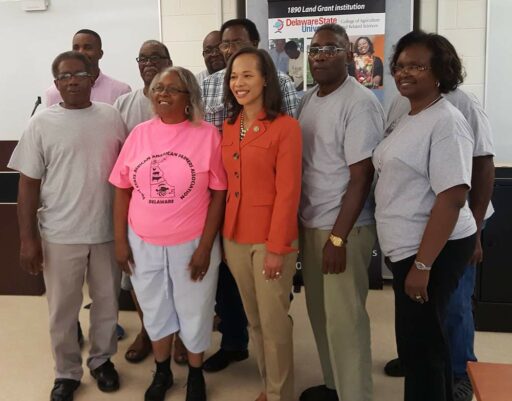
Group of people posing for picture

Research grant lays groundwork for formation of First State African American Farmers Association

Andy Wetherill, an Extension Educator at Delaware State University (DSU) and a member of NERCRD’s Technical Advisory Committee, knew from his participation in a USDA-funded capacity-building grant that farmers who work together can take advantage of economies of scale and can benefit from learning together. Using an output from that project—a manual that guides Extension educators through the process of conducting network analyses of farmer groups—Wetherill helped a group of minority farmers in Delaware form a new network: The First State African American Farmers Association (FSAAFA).

Small grants program continues with “Marketing Hometown America” project

With funding from the Northeast Center, a multi-state team will bring the Marketing Hometown America program to the Northeast Region. The team is composed of members from Penn State Extension, West Virginia University Extension, and University of New Hampshire Extension.

Two Center-related research papers recognized with awards

Stephan Goetz and his co-authors recently received awards for their published research from the National Extension Association of Family and Consumer Sciences and from Emerald Publishing.

New method of analyzing networks reveals hidden patterns in data

A new way of measuring how relationships in a network change over time can reveal important details about the network, according to researchers at the Northeast Regional Center and the Korean Rural Economic Institute. For example, when applied to the world economy, the method detected the greatest amount of network change during 2008-09, the time of the global financial crisis.

Location, location, location: Where and how do food hubs flourish?

For a new food hub to succeed, it should be located in a community with a population sufficient to sustain it, according to a team of economists, who found that a county seeking to establish its first food hub needs roughly 182,000 residents for that food hub to break even. Their findings could help funding agencies establish criteria to determine whether and where new food hubs should be added.

Connecting downtowns and trails: new infobrief provides key findings from multi-state inquiry

With funding from the Northeast Center, a team of Extension staff and faculty from five states explored how communities can leverage their existing trail systems to promote vibrant downtown economies. They’ve recently released an infobrief that summarizes what they learned.

Measuring network rewiring over time

A new paper by Stephan Goetz and former Northeast Center research associate Yicheol Han advances the field of network science by introducing a new method of measuring how relationships in networks change over time. It was published in PLOS ONE this month.